Culinary Literacy Service at the Nevada County Community Library
Goals & Objectives
For three years, Nevada County Community Library has been offering youth ages 0-18 Lunch at the Library during its Summer Learning Program (Friends of the Nevada County Libraries, 2019). In its first summer, the program reached almost 2,000 participants (Friends of the Nevada County Libraries, 2019). By the end of 2021’s summer program, Lunch at the Library had reached almost 3,000 children and teens, with another 1,500 youth also being served breakfast (Lunch at the Library, 2021). While meals were available only to youth, feedback from caregivers showed that access to food for their children meant that they were also able to eat at home since their children had been already been fed (Lunch at the Library, 2021). These numbers reflect food insecurity in Nevada County, something that could be addressed through Culinary Literacy programming at the public library. While these programs would begin in the youth services department, it has the potential to grow into adult services in the future.
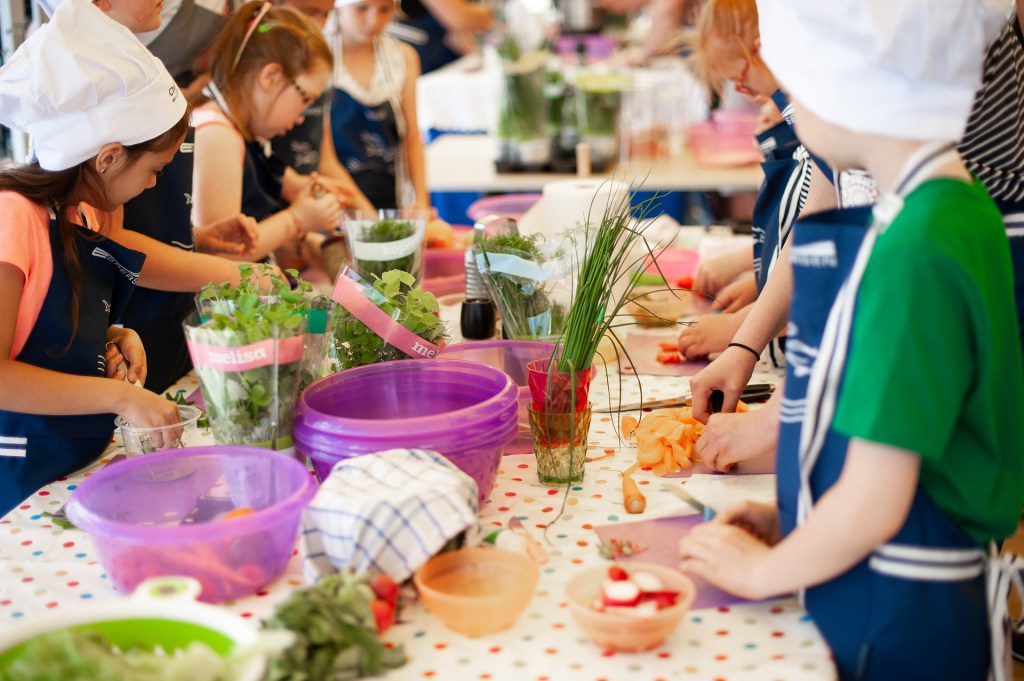
As Stephens (2014) stated, library spaces can be community-learning spaces, giving patrons the opportunity to learn, explore, and be creative. By focusing on food and ways to prepare it, tweens and teens can be empowered to create meals for themselves and their families. The interactive model will begin virtually with grab-and-go bags that contain pantry staples and will move to an in-person format once it has been deemed safe to do so by the County Librarian and Public Health. Culinary Literacy uses a different type of virtual format, requiring participants to email or direct message photos and lists of ingredients of their creations to the Youth Services Librarian. A discussion on Zoom the following month gives young patrons the opportunity to interact with each other, trade success stories as well as failures, laugh about the process, and learn from one another. Stephens (2014) discussed how offering learning opportunities can bring people together, and this is a great way to achieve this goal. It also gives youth the building blocks to being more confident with meal preparation. Suggestions to use cookbooks, as well as the library’s digital resources, will be given each month, with some helpful links as a way for tweens and teens to know how to begin. A monthly drawing for participants—with bonus entries for palatable meals—will be another way to draw patrons in, establishing the habit of attendance for a wider spectrum of programs once in-person programming is an option.
Once in-person programming is available, Culinary Literacy will offer classes on cooking basics, nutrition science, and shopping on a budget, though the virtual format that was introduced as the first step will also continue to be offered. Aspects similar to other libraries’ Adulting 101 programs will be addressed (Ford, 2018). Local bakers, cooks, and chefs will be invited to share their knowledge through demonstrations. The Food Bank of Nevada County and local grocery stores will also be invited to contribute. An ongoing youth TV program in partnership with Nevada County Media will be accessible through their station as well as on YouTube. Working with these community agencies and individuals will aid in growing community connections. As Casey (2011) explained, the participatory library communicates through many mechanisms in order to involve its community.
Community
The community to be engaged will be youth ages eight to 18, i.e. tweens and teens, who use the Grass Valley Library—Royce Branch as their main public library in Nevada County, California as well as those accessing the library through virtual methods.
Action Brief Statement
Patrons
Convince teens and tweens that by participating in Culinary Literacy programming they will gain knowledge and experience with meal preparation which will aid them in nutrition literacy because cooking and preparing meals are important aspects of nutritional health and living on a budget.
Library Administration
Convince library administration that by supporting Culinary Literacy Service they will be addressing the needs of the community which will build stronger patronage because families’ food insecurity will be addressed by the public library and community partners. It will also create more interest and youth participation in the library. As Casey & Stephens (2008) stated, “If we don’t get them in as kids and keep them as teens, we likely won’t see them later in life.”

Evidence and Resources
🍋ALSC Building Partnerships. (2018, April 17). Libraries partner with community agencies to help fight food insecurity. ALSC Blog. https://www.alsc.ala.org/blog/2018/04/libraries-partner-with-community-agencies-to-help-fight-food-insecurity/
🍋Bruce, J., De La Cruz, M., Moreno, G., & Chamberlain, L. (2017). Lunch at the library: Examination of a community-based approach to addressing summer food insecurity. Public Health Nutrition, 20(9), 1640-1649. https://doi.org/10.1017/S1368980017000258
🍋Collins, L. (2021, April 9). Feeding more than minds at the library. Public Libraries Online. http://publiclibrariesonline.org/2021/04/feeding-more-than-minds-at-the-library/
🍋I Love Libraries. (2020, July 7). Hunger is on the rise during COVID-19: Here’s what libraries are doing to help. http://www.ilovelibraries.org/article/hunger-rise-during-covid-19%E2%80%94here%E2%80%99s-what-libraries-are-doing-help
🍋Lenstra, N. (2018, October 19). Libraries help each other address food insecurity through programming. Programming Librarian. https://programminglibrarian.org/blog/libraries-help-each-other-address-food-insecurity-through-programming
🍋Llewellyn, T. (2021, July 17). How public libraries are part of the solution to food insecurity. Shareable. Retrieved October 10, 2021, from https://www.shareable.net/how-public-libraries-are-part-of-the-solution-to-food-insecurity/
🍋The Nutrition Society. (n.d.). Rethinking the public library: A new model for addressing food insecurity. https://www.nutritionsociety.org/papers/rethinking-public-library-new-model-addressing-food-insecurity
🍋States, D. (2015). Out of the pickle: Promoting food science and stem in public libraries. Pennsylvania Libraries: Research & Practice, 3(2), 102–114. https://doi.org/10.5195/palrap.2015.103
🍋Udell, E. (2019, May 1). Food for thought. American Libraries Magazine. https://americanlibrariesmagazine.org/2019/05/01/library-campus-food-insecurity-food-for-thought/
Mission, Guidelines, and Policy
As Buckland (1998) stated, “The central purpose of libraries is to provide a service: access to information” (p. 1). One of the goals of library programming is to offer the community informational and cultural experiences (OWLSweb, n.d.). The Youth Services Librarian will be involved in setting policies, with review and approval by the Branch Manager and County Librarian. ALA Standards and Guidelines will be reviewed and incorporated where needed (American Library Association, n.d.). The Nevada County Library’s strategic plan will also be incorporated, including its mission to “create an inclusive environment that fosters discovery, connect our community with innovative opportunities, and inspire lifelong learning and personal growth” (Nevada County, n.d.). The Teen Leadership Committee will also provide their insight and ideas into creating programming and special events related to Culinary Literacy Service.
The Nevada County Board of Supervisors has approved a large programming budget in accordance with the library’s Strategic Plan’s focus on providing enrichment activities for children and teens (Nevada County, n.d.). The virtual launch with grab-and-go pantry staples will cost approximately $20 a month. Once in-person programming goes into effect, monthly costs could range from $20 to $250 depending on materials and classes run by local talent, using up to a quarter of the Grass Valley Library’s programming budget.
Programs will be offered only virtually at first, then in the Grass Valley Library’s Children’s Room as well as community kitchens and the kitchen at Nevada County Media. MOUs will be required for partnerships including The Nevada County Food Bank. Local bakers, cooks, and chefs will be required to fill out vendor forms as well as volunteer applications where warranted. The ongoing contract with Nevada County Media will cover the creation of the youth TV show and the use of its kitchen.
Action Steps & Timeline
The virtual aspect of Culinary Literacy can begin right away since it is inexpensive and does not require much staff time. In-person programming can begin as soon as it is safe. Current expectations are the spring of 2022. During the gap between virtual and in-person offerings, community partnerships will be pursued and finalized, as well as dates for the cooking classes, food budgeting classes, and incorporating Food Bank produce and other resources into the lesson plans.
Casey & Stephens (2007) suggested that choosing what fits for your library can avoid the problem of “no.” By using the successful Lunch at the Library as a springboard, creating a Culinary Literacy Service is more likely to receive a “yes” by library administrators. If a “no” is still the only option presented, Grass Valley Youth Services will discuss with community partners how this service can still be offered at their locations, with the library acting as a means of promotion and marketing.
Staffing will be provided by Grass Valley Youth Services as part of their programming goals and expectations. Additional support will be offered from library volunteers and the Teen Leadership Committee and potentially one more Library Assistant.
Training
Understanding programming that does not directly involve books can be a challenge for some library staff. The Grass Valley Youth Services Librarian will train staff on how to conduct the programming as well as on the needs and community interest behind it. All staff at the Grass Valley Library will be trained on the topics of the Culinary Literacy Service and will be expected to mention it during interactions at the circulation desk when appropriate. Former surveys have shown that word of mouth is one of the most successful ways the library has for promotion.
A workshop lead by the Youth Services Librarian will be scheduled for a week before the first event during morning hours before the library opens to the public. That workshop will include the Youth Services Library Assistant as well as one other Library Assistant. All staff who are involved with the Culinary Literacy Service will also go through ServSafe Food Handler training. Most staff have been certified because of Lunch at the Library, but additional staff and renewals of the certification may be needed at a cost of $15 per staff member. This training will only be required once in-person events begin.
Promotion & Marketing
As Edelstein (2010) suggested, make sure social media promotion is fun. Nevada County Community Library’s best engagement is when it incorporates the “social” in social media. Promotion through Facebook, Instagram, and the library’s blog will be done with engaging images, asking the community for input, and maybe even a few memes. Promotion will also involve community members’ pages and platforms where the library can be tagged or posts reshared.
More traditional media promotions of press releases and online community event calendars will also be used as well as flyers posted in laundromats, bus stops, and announcement boards. Within the library, physical flyers will also be posted as well as on the library’s digital announcement board.
Quarterly surveys will be held in order to ascertain if the goals of the service are being met for youth and their caregivers. Casey and Savastinuk (2009) recommend being aware of changes in the community and how this can affect a library event. Those changes may mean there is even more need, or less of a need, for Culinary Literacy Service than there was in the past. Because of this, participation statistics will not be the only metric used. Rather, the stories gleaned from the surveys and staff interaction will be used to assess success and will carry more weight as a benchmark. These personal stories will also be a way for the Board of Supervisors and other community leaders to understand the impact of this program.
In the future, this service can be expanded into adult services. The Adult Services Librarian and her team can use the successful elements to build upon and improve the programs for adult interest. Programs can also be reformated to include younger children, and baking classes could be used as a way to teach STEM through fractions in measurement as well as weights and volumes and the science behind a rising cake or solidifying candy.
References
American Library Association. (n.d.). ALA Standards & Guidelines. Tools, Publications & Resources. https://www.ala.org/tools/guidelines/standardsguidelines
Buckland, M. K. (1998). Redesigning library services: A manifesto. American Library Association.
Casey, M. (2011, October 20). Revisiting participatory service in trying times – a TTW guest post by Michael Casey. Tame the Web. https://tametheweb.com/2011/10/20/revisiting-participatory-service-in-trying-times-a-ttw-guest-post-by-michael-casey/
Casey, M. E., & Savastinuk, L. C. (2009). Library 2.0: A guide to participatory library service. Information Today.
Casey, M., & Stephens, M. (2008, May 15). Embracing service to teens. Tame the Web. https://tametheweb.com/2008/05/15/embracing-service-to-teens/
Casey, M., & Stephens, M. (2007, May 1). Turning “no” into “yes”. Tame the Web. https://tametheweb.com/2007/05/01/turning-no-into-yes/
Edelstein, M. (2010, June 25). How to: Evaluate your social media plan. Mashable. https://mashable.com/archive/evaluate-social-media-plan
Ford, A. (2018, May 1). Adulting 101. American Libraries Magazine. https://americanlibrariesmagazine.org/2018/05/01/adulting-101-library-programming/
Friends of the Nevada County Libraries. (2019, Winter). Among friends – ncfol.org. http://www.ncfol.org/uploads/3/0/4/2/30428732/fotl_winter_2018_screen.pdf
Lunch at the Library. (2021). [Unpublished raw data]. [Findings and statistics reported to the California State Library] [Unpublished raw data]. Nevada County Community Library.
OWLSweb. (n.d.). Xi. programming policy. https://www.owlsweb.org/l4l/slpspl/XI
Stephens, M. (2014). The heart of librarianship: Attentive, positive, and purposeful change. American Library Association.


 Book Syrup
Leave a comment