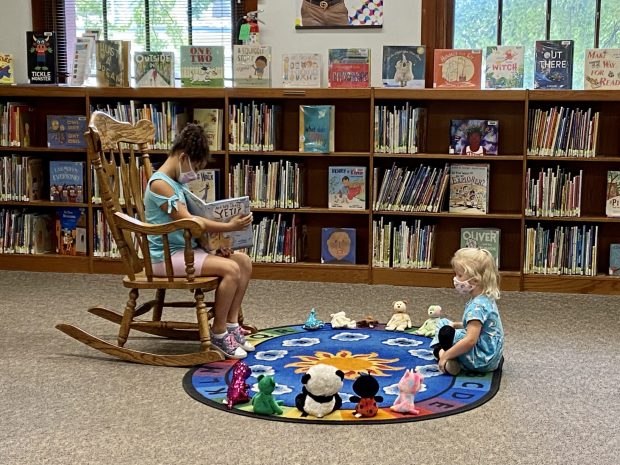
There are many types of learning. We can learn a lot just from observing—just paying attention in a library space can lead to many learning opportunities—and that observation can lead to even more levels of learning. Modeling is a technique used when training new staff members. Someone who has worked on the circulation desk for years can show how to be more efficient to a new employee or what the library’s cultural expectations for interacting with staff and the public are. Modeling is also used by librarians as a way for both children and their caregivers to learn early literacy skills. Children take that modeling and turn it into play, similar to what The Lego Foundation (2016) used when teaching a new skill. As they found, every result was different, but they were all valuable (The Lego Foundation, 2016). Play is also a part of sensory learning and experience, as was shown in the Marsden Library’s Sensory Space (Public Libraries Connect, 2020).
Play as a learning experience is something that we talk about a lot in early literacy. In fact, the five early literacy practices are talk, sing, read, write, and play (Ghoting & Martin-Díaz, 2013). I discuss those practices at the beginning of every storytime, reminding caregivers that there are many aspects that are important to learning. The photo above of one of my storytime graduates is a good example of both play and modeling. I try to bring that knowledge of play as a literacy practice into my training as well, remembering to approach it with a sense of fun along with the goal of teaching. It is easier to retain information when one is not stressed out, after all.
Library staff is lucky enough to get to learn every day. Each patron who walks through the door brings their own experiences and ways of looking at the world, and that can be amazing. Those unique perspectives can also be stressors. As Simon (2020) stated, expressing expected emotions when interacting with the public is its own form of labor and one that often leaves librarians feeling drained. When I was a cashier at a grocery store, I often interacted with 100 people during a shift. That was 100 different Mellisas I also needed to be, as each customer expected something slightly different from the last. As an introvert, I often needed to sit in a quiet room with the lights dimmed for a long period of time in order to recover after a shift. That emotional labor is also a core component of library work (Simon, 2020). As Simon (2020) found, having something that challenged library staff outside of public interaction helped in dealing with that stress.
That brings us back to learning. As supervisors, we can offer all staff opportunities to enrich their experiences at work. We can offer them training in how to deal with emotional labor, but we can also offer more. As Sally (2016) found, making the library a classroom for frontline employees can help to offer professional development for those who often get left behind. By utilizing tools like the 3-2-1 plan discussed by Stephens (2019), we can reinforce the importance of that learning within the job. I recently signed up my assistant for a webinar series that explores outreach opportunities as well as teaching literacy to school-age children. She had been feeling run down and uninspired, but since beginning the course, her eyes are sparkling, she is coming to me with new ideas for how to incorporate what she learned, and she is passionate about her job again. We discuss the training, I reinforce what she has learned with my own experience, and as her supervisor, I support her excitement by finding ways for her to use her new knowledge in the field. Learning can be good stress, an enriching experience, and it can be an amazing tool to keep employees engaged and the library a relevant place in the 21st Century.
References
Ghoting, S. N., & Martin-Díaz, P. (2013). Storytimes for everyone!: Developing young children’s language and literacy. ALA Editions, an imprint of the American Library Association.
The Lego Foundation. (2016). What do we mean by learning through play? [Film]. Vimeo. https://www.legofoundation.com/en/learn-how/knowledge-base/what-we-mean-by-learning-through-play/
Public Libraries Connect. (2020, February 17). Check out Marsden Library’s Sensory Space! https://plconnect.slq.qld.gov.au/blog/check-out-marsden-librarys-sensory-space
Sally. (2016, June 24). The library as a classroom for library staff. FINDING HEROES. https://findingheroes.co.nz/2016/06/28/the-library-as-a-classroom-for-library-staff/
Simon, K. (2020). Emotional labor, stressors, and librarians who work with the public. School of Information Student Research Journal, 10(1). https://doi.org/10.31979/2575-2499.100106
Stephens, M. (2019). Whole-hearted librarianship: Finding hope, inspiration, and balance. American Library Association.


 Book Syrup
Leave a reply to Michael Stephens Cancel reply